A number of reports this week document notable successes of the Affordable Care Act (ACA) despite Republicans' scorched-earth attempts at nullification.
On Monday, the nonpartisan Congressional Budget Office (CBO) forecast that government expenditures for the ACA would be $5 billion lower than anticipated this year and $109 billion lower than anticipated for the next decade.
The budgetary news is good in and of itself, but the principal reason behind it--that private health insurance premiums would be much lower than expected (thus requiring fewer subsidies)--was even better. The lower expenditures also come despite other good but potentially costly news--higher than expected enrollments in the health insurance exchanges.
The CBO now forecasts that 12 million more Americans will have health insurance coverage in 2014 (and 19 million more in 2015) than they would have in the absence of the ACA.
Health insurance coverage would be higher still were it not for Republicans' cynical strategy to undermine the ACA for purely partisan purposes. Indeed, Gallup estimates that between 2013 and the first quarter of 2014 the proportion of uninsured non-elderly adults dropped three times faster in states that set up their own health insurance exchanges and accepted the federal government's fully-paid offer to expand Medicaid coverage to low-income working families than in states that rejected these policies.
The truly despicable aspect of Republicans' nullification strategy is its cynical use of low- and moderate-income workers. These are Americans who "play by the rules" by working, even though their wages are incredibly low. They are also the Americans that Republicans say that the non-working poor should emulate.
Unfortunately, they are also the Americans that Republicans have thrown under the bus, by denying many access to Medicaid.
How perverse are these policies? Consider North Carolina, where a working single mother with one child loses eligibility for Medicaid once her countable income reaches $434 per month. A single mother in a minimum-wage ($7.25/hour) job would lose her eligibility after working 83 hours per month (20 hours per week). Talk about cruel incentives and a horrible choice--work more than part-time or have health insurance!
In other Republican-led states, governors and legislators have undermined the ACA (and their own constituents) by going after organizations that helped to sign low- and moderate-income families up for federally-subsidized insurance.
And these actions have been compounded by Republican actions to underfund the ACA's implementation and to sow as much uncertainty and confusion as possible.
In all of this, who gets hurt? Low- and moderate-income working families without insurance.
And despite this, the law is working.
Showing posts with label health insurance. Show all posts
Showing posts with label health insurance. Show all posts
Wednesday, April 16, 2014
Wednesday, February 26, 2014
How to make the health system worse
Republicans' crocodile tears over people losing their health insurance coverage appear to have dried.
The House is preparing to take up H.R. 2575, which would alter portions of the Affordable Care Act to allow more businesses to avoid providing providing health insurance to their employees.
The legislation is co-sponsored by Rep. Howard Coble and other members of the Republican NC delegation.
An analysis by the Congressional Budget Office gives the easily predictable result--lots of people (about 1 million by the CBO's estimate) will lose their employer-based insurance each year.
On top of that, the CBO estimates that the legislation would
Less private insurance, more public insurance, bigger deficits, and more costs for states--that's the Republican recipe for "reform."
The House is preparing to take up H.R. 2575, which would alter portions of the Affordable Care Act to allow more businesses to avoid providing providing health insurance to their employees.
The legislation is co-sponsored by Rep. Howard Coble and other members of the Republican NC delegation.
An analysis by the Congressional Budget Office gives the easily predictable result--lots of people (about 1 million by the CBO's estimate) will lose their employer-based insurance each year.
On top of that, the CBO estimates that the legislation would
- swell Medicaid and State Children's Health Insurance Program rolls by 500,000 to 1,000,000 people,
- increase the number of uninsured people by up to 500,000, and
- add to the federal debt by $73.7 billion over the next ten years.
Less private insurance, more public insurance, bigger deficits, and more costs for states--that's the Republican recipe for "reform."


Sunday, February 23, 2014
What Sheila Salter isn't telling you
Today's News & Record includes an op-ed by Sheila Salter, a 61-year-old self-employed marketing consultant from Chapel Hill, describing the cancellation (later rescinded) of her NC Blue Cross Blue Shield policy.
The (eventual) cancellation of Ms. Salter's insurance may be costly. However, Ms. Salter misrepresents some parts of her story and omits some others. The cancellation, regrettable as it is, is not nearly as costly as she makes it out to be.
The most important misrepresentation is that a $584 per month "bronze" plan is the cheapest she could buy. In fact, the $584 plan is the most expensive "bronze" plan she could buy. There are seven other "bronze" plans in Chapel Hill; the least expensive costs $150 less per month.
...my provider (Blue Cross Blue Shield) suggested a new policy that would roughly replace my canceled one. They recommended a "bronze" plan--the cheapest plan I could buy. It cost a whopping $584 per month. My current plan, by comparison, cost me only $202 per month.Ms. Salter made similar claims in testimony to the House of Representatives in November and in ads produced by the Koch-funded American's for Prosperity.
I could hardly contain my shock. My new Obamacare-compliant plan would cost me 189 percent more. It also increased my deductible from $3,500 to $5,000 and increased my co-pays from $25 to $45.
The (eventual) cancellation of Ms. Salter's insurance may be costly. However, Ms. Salter misrepresents some parts of her story and omits some others. The cancellation, regrettable as it is, is not nearly as costly as she makes it out to be.
The most important misrepresentation is that a $584 per month "bronze" plan is the cheapest she could buy. In fact, the $584 plan is the most expensive "bronze" plan she could buy. There are seven other "bronze" plans in Chapel Hill; the least expensive costs $150 less per month.
Tuesday, February 18, 2014
160,000 NC residents enrolled thru health exchange--so far
There's good news to report about the new individual health insurance exchanges that are now operating under the Affordable Care Act.
Nationally, just under 3.3 million people enrolled in individual insurance plans through the state- and federally-run exchanges during their first four months of operation, according to figures from the U.S. Department of Health and Human Services. In North Carolina, just over 160,000 people had selected an individual plan.
Although NC is 10th among states in population, it was 5th among states in private, individual health insurance enrollments during the first four months of the insurance exchanges. An additional 48,000 people were assessed as being eligible public insurance for Medicaid or the State Children's Health Insurance Program.
To put the figures in context, approximately 1.7 million North Carolinians lacked health insurance prior to the exchanges opening.
The high levels of enrollments aren't the only good news.
Nationally, just under 3.3 million people enrolled in individual insurance plans through the state- and federally-run exchanges during their first four months of operation, according to figures from the U.S. Department of Health and Human Services. In North Carolina, just over 160,000 people had selected an individual plan.
Although NC is 10th among states in population, it was 5th among states in private, individual health insurance enrollments during the first four months of the insurance exchanges. An additional 48,000 people were assessed as being eligible public insurance for Medicaid or the State Children's Health Insurance Program.
To put the figures in context, approximately 1.7 million North Carolinians lacked health insurance prior to the exchanges opening.
The high levels of enrollments aren't the only good news.
Tuesday, January 28, 2014
Sen. Burr's very, harrumph, serious proposal
We have to protect our phoney baloney jobs here, gentlemen! We must do something about this immediately! Immediately! Immediately! Harrumph! Harrumph! Harrumph!Sen. Richard Burr (R-NC) along with Senators Orrin Hatch and Tom Coburn want you to know that they've released a very serious proposal to repeal and replace the Affordable Care Act (ACA).
Gov. W. J. Le Petomane
The proposal isn't an actual bill--you know, the kind of document that could face actual scrutiny or be scored by the Congressional Budget Office. It's more of a proposal to develop a plan to develop a bill.
And the first section, which calls for the repeal of the ACA, harrumph, has a teensy weensy footnote that says that everything will be repealed "except the changes to Medicare." No sense getting that serious.
They also propose a "truly compassionate approach to Medicaid" that would eliminate the ACA's federal funding for many poor and near-poor working adults, cap federal funding at that reduced level (eliminating the matching of state expenditures that currently occurs), and restrict further increases to population growth, inflation, and an extra one percent.
Can I get another harrumph for the one percent growth?
The senators have also undertaken some very serious outreach to the rest of their extremist party by signing up ZERO House or Tea-party members.
So, let me offer a modest suggestion for Sen. Burr and his colleagues. Write an actual bill; pass it in the House; and bring that to the President and Senate Democrats to discuss.
Seriously. Harrumph!
Friday, January 24, 2014
Health exchange enrollments reach 3 million
The Hill reports that enrollments in the Affordable Care Act (ACA) health insurance exchanges have reached 3 million part way through January.
The news follows yesterday's findings by Gallup that health insurance rates among adults had jumped in January.
About 3 million people have selected a healthcare plan under ObamaCare, Health and Human Services (HHS) Secretary Kathleen Sebelius announced at an event in Jacksonville, Fla., on Friday.The news was a surprise because January and February were expected to be slow enrollment months.
HHS confirmed to The Hill that about 800,000 people have enrolled so far in January, on top of the 2.2 million who selected plans from October through December.
The news follows yesterday's findings by Gallup that health insurance rates among adults had jumped in January.
Thursday, January 23, 2014
Insurance coverage among adults increases
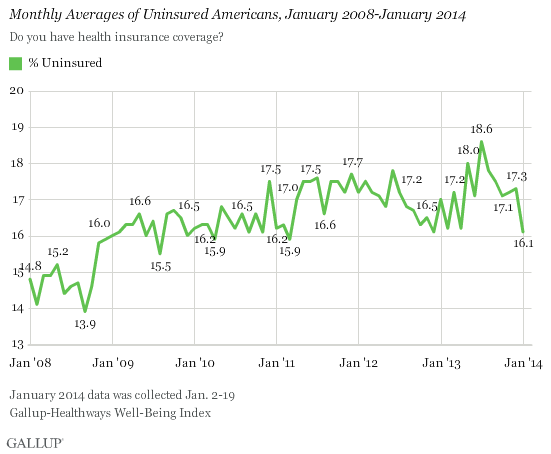
Gallup has released a new poll reporting that health insurance coverage among American adults increased modestly in January 2014, the first month that the Affordable Care Act health insurance exchange and expanded Medicaid policies were operating.
The graph below shows the estimates over time of the percentage of Americans who were uninsured--the insurance rate is 100 minus these figures and trends in the opposite direction.*

The poll, which interviewed 9,000 U.S. adults, has a sampling error, so the actual January figure is likely somewhere within 1 percent up or down of the reported figure.
Demographic breakdowns in the poll indicate that insurance coverage increased among all groups, with women, non-whites, people aged 35-64, middle-income families, and the unemployed experiencing the greatest gains in coverage.
Although the figures are consistent with the ACA improving health care coverage (that is, with increases in health exchange and Medicaid coverage outweighing the cancellation of some private plans and long-standing trends that had reduced private coverage), it's still too early to tell from poll results. As the chart above shows, sampling error causes the estimates to bounce around from month to month.
*Update 1/23/14 9:56 a.m.: Following up on a suggestion by Andy Brod, the post has been updated to clarify that the graph shows the uninsurance rate.
The graph below shows the estimates over time of the percentage of Americans who were uninsured--the insurance rate is 100 minus these figures and trends in the opposite direction.*
The poll, which interviewed 9,000 U.S. adults, has a sampling error, so the actual January figure is likely somewhere within 1 percent up or down of the reported figure.
Demographic breakdowns in the poll indicate that insurance coverage increased among all groups, with women, non-whites, people aged 35-64, middle-income families, and the unemployed experiencing the greatest gains in coverage.
Although the figures are consistent with the ACA improving health care coverage (that is, with increases in health exchange and Medicaid coverage outweighing the cancellation of some private plans and long-standing trends that had reduced private coverage), it's still too early to tell from poll results. As the chart above shows, sampling error causes the estimates to bounce around from month to month.
*Update 1/23/14 9:56 a.m.: Following up on a suggestion by Andy Brod, the post has been updated to clarify that the graph shows the uninsurance rate.
Tuesday, February 12, 2013
The Audacity of Nope
Showing his own profile in discourage, North Carolina Governor Pat McCrory agreed with Republican legislators that the state should not expand its Medicaid program nor run its own health exchange. His feeble excuse is that the state is too feeble.
Apparently, the Governor's last few years in the political wilderness have left him tanned, rested, and not ready.
Gov. Pat McCrory doesn’t think the state is ready to expand Medicaid or ready to run its own health exchanges – two provisions of the Affordable Care Act.According to the Governor, NC is not ready for better health and longer lives for hundreds of thousands of its most vulnerable citizens, tens of thousands of jobs, more productive workers, billions in economic output, and billions in savings in hospitals' uncompensated care.
McCrory’s office made the announcement Tuesday morning just hours before the state House is supposed to take up a bill that would bar the state from participating in those two actions. The Senate passed the bill last week.
Apparently, the Governor's last few years in the political wilderness have left him tanned, rested, and not ready.
Monday, February 4, 2013
Medicaid expansion and jobs
"Own goals" in soccer occur when a team kicks the ball into its own net, resulting in a point for the other team. Own goals are usually accidents.
The Republican-led North Carolina General Assembly seems poised to score an own goal against its own economy--on purpose.
Legislation is moving forward in the General Assembly to opt out of the Medicaid expansion under the Affordable Care Act. The expansion would provide health insurance to people living in households with incomes below 133 percent of the poverty line. The federal government would cover 100 percent of the costs for the first three years and 90 percent of the costs thereafter.
Besides extending coverage to about 400,000 poor NC residents who wouldn't get health insurance otherwise, the expansion would bring in $40 billion on net (about $50 billion in total spending), which would jolt the economy and create jobs.
A new report by Regional Economic Models, Inc. forecasts that the expansion would add nearly 6,000 jobs to the NC economy in the first year of the expansion, as participation in Medicaid starts to grow, and 20,000 to 25,000 jobs in subsequent years, as participation stabilizes at a higher level. A figure showing the predicted job growth appears below.
These are substantial numbers of jobs, especially for an economy that only managed to add 72,000 in total last year.
The Republican-led North Carolina General Assembly seems poised to score an own goal against its own economy--on purpose.
Legislation is moving forward in the General Assembly to opt out of the Medicaid expansion under the Affordable Care Act. The expansion would provide health insurance to people living in households with incomes below 133 percent of the poverty line. The federal government would cover 100 percent of the costs for the first three years and 90 percent of the costs thereafter.
Besides extending coverage to about 400,000 poor NC residents who wouldn't get health insurance otherwise, the expansion would bring in $40 billion on net (about $50 billion in total spending), which would jolt the economy and create jobs.
A new report by Regional Economic Models, Inc. forecasts that the expansion would add nearly 6,000 jobs to the NC economy in the first year of the expansion, as participation in Medicaid starts to grow, and 20,000 to 25,000 jobs in subsequent years, as participation stabilizes at a higher level. A figure showing the predicted job growth appears below.
 |
| Figure from REMI report "A Contrast: Modeling the Macroeconomic Impact of 'Medicaid Expansion' in North Carolina. |
Thursday, January 31, 2013
Noses, faces, Medicaid expansion
As policy choices go, the direction North Carolina should take with respect to Medicaid expansion couldn't be clearer. However, we live in interesting times.
Medicaid is a public health insurance program for certain groups of poor and needy people, mostly poor children, poor elderly people, poor blind and disabled people, and recipients of federal cash assistance. With the exception of pregnant women and some parents, NC's Medicaid program generally does not cover able-bodied, working-age adults. Not surprisingly, hundreds of thousands of poor and near-poor working-age adults in the state are uninsured.
Provisions of the Affordable Care Act (ACA) are supposed to change that, starting in 2014. The ACA allows states to expand Medicaid eligibility to all low-income people, living in households with incomes below 133 percent of the federal poverty line. For the first three years of the expansion, the federal government will pay 100 percent of the costs. Starting in 2017, participating states will have to contribute $1 for every $9 that the federal government pays.
In the original legislation, states risked losing all their federal Medicaid money if they chose not to expand their programs. However, the Supreme Court decision upholding most of the ACA scaled that back, and non-participating states will now only forfeit the federal funds directly tied to the expansion. The Supreme Court made it less costly for states, like NC, controlled by the Party of No to, um, say "no."
While NC lawmakers have the ability to say "no," they would be hurting the state far more than they would be helping it.
Medicaid is a public health insurance program for certain groups of poor and needy people, mostly poor children, poor elderly people, poor blind and disabled people, and recipients of federal cash assistance. With the exception of pregnant women and some parents, NC's Medicaid program generally does not cover able-bodied, working-age adults. Not surprisingly, hundreds of thousands of poor and near-poor working-age adults in the state are uninsured.
Provisions of the Affordable Care Act (ACA) are supposed to change that, starting in 2014. The ACA allows states to expand Medicaid eligibility to all low-income people, living in households with incomes below 133 percent of the federal poverty line. For the first three years of the expansion, the federal government will pay 100 percent of the costs. Starting in 2017, participating states will have to contribute $1 for every $9 that the federal government pays.
In the original legislation, states risked losing all their federal Medicaid money if they chose not to expand their programs. However, the Supreme Court decision upholding most of the ACA scaled that back, and non-participating states will now only forfeit the federal funds directly tied to the expansion. The Supreme Court made it less costly for states, like NC, controlled by the Party of No to, um, say "no."
While NC lawmakers have the ability to say "no," they would be hurting the state far more than they would be helping it.
Tuesday, January 29, 2013
Gov. Jindal forgot something
In today's Washington Post, Louisiana Gov. Bobby Jindal asks President Obama for a meeting to discuss the expansion of Medicaid under the American Care Act (a.k.a. Obamacare).
Gov. Jindal overlooks an even bigger problem--hundreds of thousands of low-income households without insurance. The same Kaiser Family Foundation and Urban Institute report that he cites indicates that up to 398,000 low-income Louisianans (about one out of every 12 Lousianans) will gain health insurance through the Medicaid expansion in the next ten years and that the expansion will reduce the percentage of Louisianans without health insurance by up to 60 percent.
Gov. Jindal's prescription for hundreds of thousands of his state's citizens is to continue to go without health insurance while he (and other Republican governors and state houses) defer and delay.
Low-income uninsured households need to be part of the discussion.
As the implementation of Obamacare unfortunately nears, every governor must decide whether to expand Medicaid. This is not a simple question. Expanding Medicaid will significantly burden state budgets across the country.Gov. Jindal proceeds to describe how awful and inefficient Medicaid is--nevermind that states, and not the federal government, operate Medicaid programs and that states have enormous flexibility in setting the parameters of the program. But let's take Gov. Jindal's point at face value, Medicaid is far from perfect.
Our state’s analyses, and reports by organizations that have supported Obamacare, such as the Kaiser Family Foundation and the Urban Institute, estimate that such an expansion would cost Louisiana more than a billion dollars over the first 10 years.
Gov. Jindal overlooks an even bigger problem--hundreds of thousands of low-income households without insurance. The same Kaiser Family Foundation and Urban Institute report that he cites indicates that up to 398,000 low-income Louisianans (about one out of every 12 Lousianans) will gain health insurance through the Medicaid expansion in the next ten years and that the expansion will reduce the percentage of Louisianans without health insurance by up to 60 percent.
Gov. Jindal's prescription for hundreds of thousands of his state's citizens is to continue to go without health insurance while he (and other Republican governors and state houses) defer and delay.
Low-income uninsured households need to be part of the discussion.
Saturday, May 12, 2012
$27.6 million in health insurance rebates coming to NC households and businesses
In a just-completed study of the Medical Loss Ratio (MLR) provisions of the Affordable Care Act (ACA), the Kaiser Family Foundation estimates that health insurers will be rebating $27.6 million on nearly 300,000 North Carolina policies in August. Nationally, the foundation estimates that $1.3 billion will be rebated on nearly 16 million policies.
The MLR provisions of the ACA require insurers to spend a certain percentage of total premium revenue on actual health expenditures rather than things like advertising, administrative salaries, and profits (that the insurers refer to these health expenditures as "losses" tells you most of what you need to know about their incentives). Under the ACA, insurance plans that are offered to individuals or small groups are supposed to spend at least 80 percent of their premium revenues on health care claims and services, and plans that are offered to large groups are supposed to spend at least 85 percent of their premium revenues on health care. Insurers who fail to meet these MLR thresholds have to issue rebates to the people and firms that purchased the policies.
Although the ACA has been law for a few years, the MLR provisions are only now coming into effect. Also, North Carolina obtained a waiver for this year which sets its MLR threshold at 75 percent.
After a review of insurance company filings, the Kaiser Family Foundation estimates that 55,072 individual enrollees in North Carolina will be issued $6.4 million in rebates from 9 insurance plans this year, 97,670 small group enrollees will be issued $4.3 million in rebates from 5 insurance plans, and 139,156 large group enrollees will be issued $16.9 million in rebates from 6 insurance plans. Overall, rebates will be due on the plans for just over one out of every five North Carolina enrollees.
The MLR provisions help consumers in two ways. First, there are the rebates themselves, which transfer money back to consumers or businesses for plans with bloated administrative expenses and excess profits. This directly lowers the effective costs of insurance for these plans. Second, the provisions provide strong incentives for insurers to avoid these rebates by either paying a higher portion of their premium revenue in claims and services or keeping their administrative expenses and profits within reasonable levels. This indirectly lowers the net costs of insurance for all purchasers.
These provisions will disappear if Republicans or the Supreme Court repeal the ACA. In addition, U.S. Representatives Coble, Ellmers, Jones, Kissell, McIntyre, and Myrick have co-sponsored legislation (H.R. 1206) to water down the provisions by excluding insurance agents' commissions from the calculation of administrative expenses.
The MLR provisions of the ACA require insurers to spend a certain percentage of total premium revenue on actual health expenditures rather than things like advertising, administrative salaries, and profits (that the insurers refer to these health expenditures as "losses" tells you most of what you need to know about their incentives). Under the ACA, insurance plans that are offered to individuals or small groups are supposed to spend at least 80 percent of their premium revenues on health care claims and services, and plans that are offered to large groups are supposed to spend at least 85 percent of their premium revenues on health care. Insurers who fail to meet these MLR thresholds have to issue rebates to the people and firms that purchased the policies.
Although the ACA has been law for a few years, the MLR provisions are only now coming into effect. Also, North Carolina obtained a waiver for this year which sets its MLR threshold at 75 percent.
After a review of insurance company filings, the Kaiser Family Foundation estimates that 55,072 individual enrollees in North Carolina will be issued $6.4 million in rebates from 9 insurance plans this year, 97,670 small group enrollees will be issued $4.3 million in rebates from 5 insurance plans, and 139,156 large group enrollees will be issued $16.9 million in rebates from 6 insurance plans. Overall, rebates will be due on the plans for just over one out of every five North Carolina enrollees.
The MLR provisions help consumers in two ways. First, there are the rebates themselves, which transfer money back to consumers or businesses for plans with bloated administrative expenses and excess profits. This directly lowers the effective costs of insurance for these plans. Second, the provisions provide strong incentives for insurers to avoid these rebates by either paying a higher portion of their premium revenue in claims and services or keeping their administrative expenses and profits within reasonable levels. This indirectly lowers the net costs of insurance for all purchasers.
These provisions will disappear if Republicans or the Supreme Court repeal the ACA. In addition, U.S. Representatives Coble, Ellmers, Jones, Kissell, McIntyre, and Myrick have co-sponsored legislation (H.R. 1206) to water down the provisions by excluding insurance agents' commissions from the calculation of administrative expenses.
Wednesday, May 2, 2012
Health insurance mandates...Washington is and was the problem
Logical consistency has never been a strong suit of the Tea Party movement, what with signs saying "Government, Keep Your Hands off Medicare." Now it turns out that the Tea Party is historically inconsistent as well.
A pillar of the Tea Party movement is that the U.S. should return to a limited, originalist federal system that strictly adheres to the Constitutional principles of the founding fathers. In particular, the founders would never impose national mandates to purchase health insurance or other goods.
Except that they did.
Last month, historian Einer Elhauge wrote a fascinating piece in the New Republic, listing several purchase mandates, including health insurance mandates, that our first Congresses passed and that Presidents Washington and Adams signed.
Ayn Rand was not a founding father; George Washington, John Adams and many members of the first Congresses were.
If purchase mandates passed muster with those actual founding fathers, can the originalist underpinnings of these policies really be questioned?
Tea Party members are right to blame Washington for health insurance mandates; they've just got the wrong Washington.
A pillar of the Tea Party movement is that the U.S. should return to a limited, originalist federal system that strictly adheres to the Constitutional principles of the founding fathers. In particular, the founders would never impose national mandates to purchase health insurance or other goods.
Except that they did.
Last month, historian Einer Elhauge wrote a fascinating piece in the New Republic, listing several purchase mandates, including health insurance mandates, that our first Congresses passed and that Presidents Washington and Adams signed.
In making the legal case against Obamacare’s individual mandate, challengers have argued that the framers of our Constitution would certainly have found such a measure to be unconstitutional. Nevermind that nothing in the text or history of the Constitution’s Commerce Clause indicates that Congress cannot mandate commercial purchases. The framers, challengers have claimed, thought a constitutional ban on purchase mandates was too “obvious” to mention. Their core basis for this claim is that purchase mandates are unprecedented, which they say would not be the case if it was understood this power existed.
But there’s a major problem with this line of argument: It just isn’t true. The founding fathers, it turns out, passed several mandates of their own. In 1790, the very first Congress—which incidentally included 20 framers—passed a law that included a mandate: namely, a requirement that ship owners buy medical insurance for their seamen. This law was then signed by another framer: President George Washington.
...That’s not all. In 1792, a Congress with 17 framers passed another statute that required all able-bodied men to buy firearms. Yes, we used to have not only a right to bear arms, but a federal duty to buy them. Four framers voted against this bill, but the others did not, and it was also signed by Washington. Some tried to repeal this gun purchase mandate on the grounds it was too onerous, but only one framer voted to repeal it.
Six years later, in 1798, Congress addressed the problem that the employer mandate to buy medical insurance for seamen covered drugs and physician services but not hospital stays. And you know what this Congress, with five framers serving in it, did? It enacted a federal law requiring the seamen to buy hospital insurance for themselves. ...And this act was signed by another founder, President John Adams.
Ayn Rand was not a founding father; George Washington, John Adams and many members of the first Congresses were.
If purchase mandates passed muster with those actual founding fathers, can the originalist underpinnings of these policies really be questioned?
Tea Party members are right to blame Washington for health insurance mandates; they've just got the wrong Washington.
Wednesday, February 22, 2012
Those horrible, dastardly contraceptive insurance mandates--that are already in place in 28 states
Conservatives are beside themselves with indignation over the Obama administration's mandate that insurance plans include coverage for contraception and reproductive health services.
For example, Sen. Charles Grassley (R-Iowa) has written to the Secretary of Health and Human Services
Sen. Roy Blunt (R-Missouri) has also criticized the compromise version of the mandate, saying
In fact, contraception is already part of mandated insurance coverage in 28 states. Twelve of those states either have no exemptions or have exemptions that are weaker than what the Obama administration is proposing.
My home state, North Carolina, is one of those states that mandates coverage for contraception and outpatient services. It also has exclusions that are similar to those in the federal proposal.
Insurance coverage for contraception was a widely accepted (and implemented) policy a few weeks ago. Once the Obama proposed a rule along the same lines, Party of No, began gainsaying just like Pavlov's dinner bell just rang.
For example, Sen. Charles Grassley (R-Iowa) has written to the Secretary of Health and Human Services
This rule highlights this Administration’s continued invasive role in designing the health care benefits available to Americans and underscores one of the numerous concerns Americans have with the Affordable Care Act. That the definition of a preventative benefit services has morphed into a requirement to force Americans to buy a product that violates their conscience demonstrates the dramatic overreach of the law into Americans’ personal freedoms and liberties. This burdensome and morally dubious regulation stands against more than 200 years of our nation’s proud history of religious and individual liberty.Harumph! It's odd though that Sen. Grassley doesn't criticize his own state, which has an insurance mandate that employers provide contraception and outpatient services, with no exclusions.
Sen. Roy Blunt (R-Missouri) has also criticized the compromise version of the mandate, saying
It’s still clear that President Obama does not understand this isn’t about cost – it’s about who controls the religious views of faith-based institutions. President Obama believes that he should have that control. Our Constitution states otherwise.Sen. Blunt has gone so far to introduce legislation to allow any employer opt out of providing contraception through insurance plans. Maybe Sen. Blunt should first convince Missouri to drop that state's insurance mandate that includes religious exemptions but requires that insurers still allow individuals to obtain coverage.
Just because you can come up with an accounting gimmick and pretend like religious institutions do not have to pay for the mandate, does not mean that you’ve satisfied the fundamental constitutional freedoms that all Americans are guaranteed.
I’ll continue to work with my colleagues on both sides of the aisle to ensure that we reverse this unconstitutional mandate in its entirety.
In fact, contraception is already part of mandated insurance coverage in 28 states. Twelve of those states either have no exemptions or have exemptions that are weaker than what the Obama administration is proposing.
My home state, North Carolina, is one of those states that mandates coverage for contraception and outpatient services. It also has exclusions that are similar to those in the federal proposal.
Insurance coverage for contraception was a widely accepted (and implemented) policy a few weeks ago. Once the Obama proposed a rule along the same lines, Party of No, began gainsaying just like Pavlov's dinner bell just rang.
Friday, February 10, 2012
A difference in contraception provision without much of distinction
The White House, feeling the heat from Catholics' and conservatives' hysterical reactions to its original decision to treat religiously-affiliated non-profits like other employers by requiring them to include contraceptive care in their health insurance plans, announced a new policy today--or did it?
Families would have access to the same insurance coverage at the same cost as the original proposal. The only difference is that the coverage would not formally be part of the plan, and families would have to apply for coverage separately and directly with the insurer.
Pick your metaphor--fig leaf, shell game, smoke and mirrors--there isn't much of a change (though given the Catholic church's fondness for ritual and given the clergy's history of studied blindness and Catholics' general cognitive dissonance regarding contraception since Humanae Vitae in 1968, you could see how President Obama would think he could get this one past them).
Which isn't to say that the policy is costless.
The policy increases the paperwork burden for families and insurance companies. Although the coverage is "free" to families, these minor hassles along with people's inertia will undoubtedly reduce take-up. So in the end, fewer families will get coverage, and administrative costs will rise.
The usual practice of this blog is to argue on the basis of rationality. However, in this case, President Obama has proposed something so outrageously and audaciously irrational that it just might work.
Women still will be guaranteed coverage for contraceptive services without any out-of-pocket cost, but will have to seek the coverage directly from their insurance companies if their employers object to birth control on religious grounds.Huh?
Religiously-affiliated non-profit employers such as schools, charities, universities, and hospitals will be able to provide their workers with plans that exclude such coverage. However, the insurance companies that provide the plans will have to offer those workers the opportunity to obtain additional contraceptive coverage directly, at no additional charge.
Families would have access to the same insurance coverage at the same cost as the original proposal. The only difference is that the coverage would not formally be part of the plan, and families would have to apply for coverage separately and directly with the insurer.
Pick your metaphor--fig leaf, shell game, smoke and mirrors--there isn't much of a change (though given the Catholic church's fondness for ritual and given the clergy's history of studied blindness and Catholics' general cognitive dissonance regarding contraception since Humanae Vitae in 1968, you could see how President Obama would think he could get this one past them).
Which isn't to say that the policy is costless.
The policy increases the paperwork burden for families and insurance companies. Although the coverage is "free" to families, these minor hassles along with people's inertia will undoubtedly reduce take-up. So in the end, fewer families will get coverage, and administrative costs will rise.
The usual practice of this blog is to argue on the basis of rationality. However, in this case, President Obama has proposed something so outrageously and audaciously irrational that it just might work.
Thursday, February 2, 2012
Birth-control "abhorrent" to Catholics?
President Obama has come under withering criticism from a segment of the Catholic community for his decision not to exempt religious-affiliated non-profits, such as the University of Notre Dame, from new health insurance rules that require health plans to cover the cost of contraception. For example the Catholic Action League has denounced the policy, calling it "an expression of unmitigated contempt for the rights, consciences, and sensibilities of Catholics” and complaining that the institutions "will be forced to pay for procedures, devices, and chemicals abhorrent to the consciences of Catholics."
Let's put aside the fact that the exemption to religious institutions and to organizations that primarily serve or employ people from a particular religious group stands.
Those procedures, devices, and chemicals aren't abhorrent to most Catholics, at least on revealed preference grounds.
Catholics contracept at approximately the same rates as other groups. In April 2011, the Alan Guttmacher Institute released a analysis of 2006-8 data from the National Survey of Family Growth. Among sexually-active women of reproductive age who were neither pregnant, post-partum or trying to get pregnant, 89 percent of Catholics were using some form of birth control, which is identical to all women in that group. The types of contraception were also nearly identical. Rates of pill use were 31 percent for Catholics and for women generally; rates of IUD use were 5 percent for Catholics and women generally; rates of sterilization (of either the woman or her partner) were 32 percent for Catholics and 33 percent for women generally, and rates of condom usage were 15 percent for Catholics and 14 percent for women generally.
Thus, it appears that the "sensibilities" of the vast majority of Catholics include not just the tolerance but the regular use of contraceptives. The rights of these Catholics and the many non-Catholics who are employed at these tax-advantaged (and often taxpayer-supported) institutions also need to be considered.
Let's put aside the fact that the exemption to religious institutions and to organizations that primarily serve or employ people from a particular religious group stands.
Those procedures, devices, and chemicals aren't abhorrent to most Catholics, at least on revealed preference grounds.
Catholics contracept at approximately the same rates as other groups. In April 2011, the Alan Guttmacher Institute released a analysis of 2006-8 data from the National Survey of Family Growth. Among sexually-active women of reproductive age who were neither pregnant, post-partum or trying to get pregnant, 89 percent of Catholics were using some form of birth control, which is identical to all women in that group. The types of contraception were also nearly identical. Rates of pill use were 31 percent for Catholics and for women generally; rates of IUD use were 5 percent for Catholics and women generally; rates of sterilization (of either the woman or her partner) were 32 percent for Catholics and 33 percent for women generally, and rates of condom usage were 15 percent for Catholics and 14 percent for women generally.
Thus, it appears that the "sensibilities" of the vast majority of Catholics include not just the tolerance but the regular use of contraceptives. The rights of these Catholics and the many non-Catholics who are employed at these tax-advantaged (and often taxpayer-supported) institutions also need to be considered.
Friday, November 11, 2011
$12.4 million grant sits unused while state Republicans dither
North Carolina recently received a $12.4 million federal grant to help set up its health insurance exchange, but the grant is going unused because Republicans refuse to meet to provide the go ahead.
The approach is also counter-productive to Republican goals because it increases the chances that North Carolina will have to operate under a possible federal exchange program rather than a North-Carolina-run and tailored program.
In addition, the delay hurts North Carolina economically. The $12.4 million would provide an economic boost to a state that sorely needs it. Over the last year, North Carolina has effectively had no job growth, and last month, the state had the dubious distinction of leading the nation in job losses. Given that sorry record, you would think that the Republicans would feel some urgency to get the money into the economy.
Instead, much like they did with the federal unemployment money, Republicans are engaged in a senseless, self-defeating, job-killing delay.
Millions in federal money has gone unspent for weeks because legislators have put off talking to the state Department of Insurance about how a national health insurance grant will be used.Health insurance exchanges were a feature of both the Republican and Democratic proposals on health care reform and rightly so because the exchanges will increase the availability, transparency, and efficiency of health insurance. There is no good reason not to begin planning for how to set up the state's exchange.
Lawmakers dropped discussion of the $12.4 million grant from the Oct. 27 agenda of a high-powered group called the Joint Legislative Committee on Governmental Operations. Agencies must consult with the committee, which House Speaker Thom Tillis and Senate leader Phil Berger run, before spending grant money in certain circumstances.
The money is for the state to do prep work for a health benefit exchange that the federal health insurance law would require of all states by 2014. With no grant money to support it, most of the work at the state Department of Insurance and the N.C. Institute of Medicine on the exchange has stopped.
The approach is also counter-productive to Republican goals because it increases the chances that North Carolina will have to operate under a possible federal exchange program rather than a North-Carolina-run and tailored program.
In addition, the delay hurts North Carolina economically. The $12.4 million would provide an economic boost to a state that sorely needs it. Over the last year, North Carolina has effectively had no job growth, and last month, the state had the dubious distinction of leading the nation in job losses. Given that sorry record, you would think that the Republicans would feel some urgency to get the money into the economy.
Instead, much like they did with the federal unemployment money, Republicans are engaged in a senseless, self-defeating, job-killing delay.
Wednesday, October 12, 2011
Texas consumers and taxpayers suffer after malpractice "reform"
Conservatives tout caps on malpractice awards as a good medicine for the health care system and for bringing down health costs. However, a new report by the consumer organization, Public Citizen, shows that many health care outcomes in Texas got worse after 2003 when that state capped non-economic damages in malpractice cases.
From the report
From the report
The report gives evidence that doctors and insurance companies benefited, but those benefits didn't get passed on to consumers or to taxpayers generally.
- Medicare spending in Texas has risen far faster than the national average. Per-enrollee spending for Medicare’s two main programs ranked second-highest in Texas among the 50 states in 2009. In 2003, Texas ranked seventh. In light of the steep reduction in litigation that has occurred in Texas since 2003, these figures contradict the theory that medical malpractice litigation is driving health care costs.
- Medicare spending specifically for outpatient services in Texas has risen even more steeply compared to national averages.
- Premiums for private health insurance in Texas have risen faster than the national average.
- The percentage of Texans who lack health insurance has risen, solidifying the state’s dubious distinction of having the highest uninsured rate in the country.
Wednesday, April 13, 2011
NCBCBS asks not to be blamed for misdirecting premium dollars
Blue Cross and Blue Shield of North Carolina (NCBCBS) is starting a new marketing campaign to spark a discussion on reining in health care costs. The News & Observer reportshostages' customers' premium dollars toward self-serving marketing and lobbying campaigns.
Blue Cross and Blue Shield of North Carolina is tired of playing the scapegoat.At the risk of scapegoating the state's largest insurance oligopoly, let me suggest that NCBCBS first consider the cost implications of misdirecting its
The state's largest health insurer will announce this morning that it's beginning a major marketing campaign to emphasize that many parties share the blame for rising health costs. The message is that those groups, including insurers, doctors, hospitals, drug companies, lawyers and consumers, must work together to reduce medical costs.
The effort will include TV commercials and other advertising with goats portraying the various groups. The Chapel Hill company also is starting a website, www.letstalkcost.com to spur more discussion about how to control medical costs.
Tuesday, January 18, 2011
Who needs the Affordable Care Act?
Who needs the Affordable Care Act? Maybe the estimated 129 million Americans under age 65 with pre-existing health conditions.
The Party of No offers those of us with medical conditions nothing but further discrimination from insurers.
As many as 129 million Americans under age 65 have medical problems that are red flags for health insurers, according to an analysis that marks the government's first attempt to quantify the number of people at risk of being rejected by insurance companies or paying more for coverage.The ACA, which will prohibit insurers from denying coverage or charging more on the basis of existing medical problems, would be a tremendous benefit.
The Party of No offers those of us with medical conditions nothing but further discrimination from insurers.
Subscribe to:
Posts (Atom)