Tuesday, February 4, 2014

NC also dragging its feet on Unemployment Insurance

For seven months, North Carolina has delayed the processing of food assistance cases.

WRAL reports that over the same period the state has also dragged its feet on Unemployment Insurance (UI) claims.
The number of unemployed North Carolina workers who waited longer than three weeks for their initial benefit check increased after a new unemployment insurance law took effect last summer.
The delays in caseload processing are due largely to Republican-enacted changes in the state's UI system.

Besides reducing the amount of benefits, reducing the length of benefits, and imposing an extra week's delay in receiving benefits, Republicans put workers on the hook for any overage mistakes that the state made.

Closer scrutiny of new applications has led to delays in awarding benefits.

As with its problems with Supplemental Nutrition Assistance Program processing, the state is violating federal law. For UI, federal law requires that 87 percent of initial claims be paid within three weeks; however, NC has only been averaging 70 to 80 percent.

It doesn't seem that there is much that NC can do right--at least when it comes to its disadvantaged and vulnerable citizens.

NC FAST subsiding

Seven months in, the enormous, unconscionable backlog in Supplemental Nutrition Assistance Program (SNAP) applications and recertifications finally appears to be subsiding.

WRAL reports the good news.
Under the gun of a federal ultimatum, state and county health officials cut a longstanding backlog of food stamp cases nearly in half over the weekend.

Data released by the N.C. Department of Health and Human Services Monday show about 3,600 cases remain for workers to process before a Feb. 10 deadline, down from about 7,700 on Jan. 30. Case managers must complete these applications before next week or risk losing about $88 million in funding from the U.S. Department of Agriculture.
An "all-hands-on-deck" approach by North Carolina Health and Human Services Secretary Aldona Wos deserves credit for cutting the backlog.

The backlog has not been eliminated. The NC DHHS has prioritized the food assistance cases that would trigger a suspension of federal SNAP administrative funds--emergency cases that should have originally received expedited 7-day processing and cases that were delayed by three months or more. Thousands of other cases with one- and two-month delays remain and will remain--that's still thousands too many, especially considering that the new computer system that triggered this has been operating for seven months.

The good news itself also has an infuriating element: the NC DHHS was able to cut almost half of the backlog in a single weekend.

For months, Sec. Wos and the NC DHHS have engaged in a public-relations campaign in which they repeatedly downplayed the calamity and then turned to denigrating county case workers, previous administrations, health care reform, the media, and others when much of the problem--and the substantial hardship it was inflicting--could be solved with a few-day surge in workers.

Not only did it take a federal ultimatum to get Sec. Wos to feel any special urgency about actually dealing with a backlog that was keeping food from desperate families, but a reasonable-cost solution to that suffering appears to have been in-hand all along.

That's callousness of the first order.

Monday, February 3, 2014

"DIscredit Hayes"

The New Yorker details how Syngenta, a multi-national company with a large Greensboro presence, led an all-out charge to take down a critical biologist, Tyrone Hayes.
Hayes has devoted the past fifteen years to studying atrazine, and during that time scientists around the world have expanded on his findings, suggesting that the herbicide is associated with birth defects in humans as well as in animals. The company documents show that, while Hayes was studying atrazine, Syngenta was studying him, as he had long suspected. Syngenta’s public-relations team had drafted a list of four goals. The first was “discredit Hayes.” In a spiral-bound notebook, Syngenta’s communications manager, Sherry Ford, who referred to Hayes by his initials, wrote that the company could “prevent citing of TH data by revealing him as noncredible.” He was a frequent topic of conversation at company meetings. Syngenta looked for ways to “exploit Hayes’ faults/problems.” “If TH involved in scandal, enviros will drop him,” Ford wrote. She observed that Hayes “grew up in world (S.C.) that wouldn’t accept him,” “needs adulation,” “doesn’t sleep,” was “scarred for life.” She wrote, “What’s motivating Hayes?—basic question.”
Syngenta's campaign continued
According to company e-mails, Syngenta was distressed by Hayes’s work. Its public-relations team compiled a database of more than a hundred “supportive third party stakeholders,” including twenty-five professors, who could defend atrazine or act as “spokespeople on Hayes.” The P.R. team suggested that the company “purchase ‘Tyrone Hayes’ as a search word on the internet, so that any time someone searches for Tyrone’s material, the first thing they see is our material.” The proposal was later expanded to include the phrases “amphibian hayes,” “atrazine frogs,” and “frog feminization.”
Imagine how much good Syngenta could do if it devoted these resources to researching it products instead of researching how to undermine its critics.

Groundhog grade

Not-to-far-fetched news item: Emerging from his burrow on Sunday, Sen. Phil Berger saw his shadow, predicted that there would be six more weeks of third-grade for tens of thousands of North Carolina school children, and immediately crawled back into his burrow.

While above "news item" is fake, the prospect of a "Groundhog Grade" for NC third-graders and their families is all too real--and very much due to the ill-conceived meddling of Sen. Phil ("Punxsutawney Phil") Berger.

A while back, Punxsutawney Phil and his tea-party colleagues muscled through an education "reform" plan that requires third-graders to pass new reading proficiency tests. To give students the best chance of passing, most school districts are adopting a "portfolio" approach that subjects the students to 36 assessments.

Students who don't pass will be required to attend reading "camps" over the summer.

Those who don't attend the camps or fail the tests after the camps will get to do third grade over--and possibly over again.

Testing for the students is beginning and will continue for 12 weeks. It's hard to imagine much learning going on in the classrooms with students having to sit for the assessments and teachers having to conduct them.

It is estimated that somewhere between 37,000 and 75,000 students will fall short of the mark and be sent to the camps.

An analysis by the NC Department of Public Instruction  estimated that at least $18.3 million would be needed to fund the camps if 37,000 students failed the tests. However, in their wisdom, Punxsutawney Phil and his colleagues (who appear to have failed third-grade math) only allocated $15.5 million, leaving local school districts to pick up the rest of their tab.

It also looks like 37,000 is an optimistic figure--last year, more than 50,000 students (about half of all third graders) were short of proficiency.

Under-funded schools during the regular year; a long, drawn-out testing regime that interferes with learning; and woefully under-funded remedial programs are all a recipe for disaster.

If you inflicted this on NC families, you'd be crawling back into your burrow too.

Thursday, January 30, 2014

"Somewhere Pavlov is smiling"

A beloved teacher frequently admonished our class when we would reflexively start to pack up our things at the sound of the dismissal warning bell, "somewhere Pavlov is smiling."

She was referring, of course, to Ivan Pavlov, who conditioned dogs to reflexively salivate at the sound of a buzzer.

Somewhere Pavlov is smiling about Republicans' reflexive rejection of President Obama's announcement that he is creating a myRA program to help people begin saving.

The program allows for voluntary, after-tax payroll deductions--as little as $5 per week--that can be used to purchase risk-free Treasury securities with no fees charged to either the worker or his/her employer. Funds in accounts would accumulate tax free. The program mimics, on a small scale, a risk-free retirement savings option that is available to federal civil servants.

Republicans' reactions to this and nearly every other Obama initiative have followed a drearily predictable path--if the President is for it, they're against it.

This latest rejection may be one of the oddest yet, because the President's program, modest though it is, actually advances conservative principles.

Consider that by making saving easier, the program promotes self-sufficiency and ownership.

Also, the savings would be entirely privately-funded--indeed, funded by workers themselves.

In addition, every aspect of the program is voluntary. Employers are free to offer this or not as they wish; eligible employees are free to contribute or not as they wish. The only mandatory component is that employees must move their funds to a regular retirement account once their myRA savings reach $15,000.

And the returns on the savings escape taxation.

Effectively, the only thing that this program does is to eliminate the transactions costs associated with setting up or contributing to retirement accounts. As transaction costs interfere with the beneficial outcomes with free-markets (especially the amounts traded are small), the program facilitates a free-market outcome.

This may be why the Heritage Foundation and other conservative organizations have advocated for exactly these types of savings vehicles.

Right up to the point where the President agreed with them.

Come to think of it, Bugs Bunny might be smiling too.

Wednesday, January 29, 2014

"I'll break you in half, like a boy"

Stay classy, Republicans.

Republicans near, far (and increasingly far-out) seem to be losing it.

Locally, state Sen. Bill Rabon's delivered a profane, arrogant, and condescending tirade against his constituents, General Assembly "colleagues," the Governor, and the state's first lady--basically everyone except state Sen. Bill Rabon.

In Washington (we think), Rep. Steve Stockman (R-TX) re-appeared on Monday after a mysterious and unexplained absence, claiming that part of it was a game of hide-and-seek with the media.

Last night, just prior to the President's state of the union speech, Rep. Randy Weber (R-TX) tweeted,
On floor of house waitin on "Kommandant-In-Chef"...the Socialistic dictator who's been feeding US a line or is it "A-Lying?"
And following the speech, Rep. Michael Grimm (R-NY) menaced a reporter, yelling
Let me be clear to you: If you ever do that to me again, I'll throw you off this f***ing balcony.
After the reporter attempted to reply, the aptly-named Rep. Grimm continued
No, no. You're not man enough, you're not man enough. I'll break you in half, like a boy.

At least they're not threatening to blow up the economy...this week.

Tuesday, January 28, 2014

"He’s a little nothing of a man”

So says, Janie Withers, the president of Paws-Ability after her meeting with NC state Sen. Bill Rabon.

Sen. Rabon begs to differ
I’m going to tell you one more time. Let me back up. Let me blow my own horn. I have been there for three years. I’m in the top five . . . The best shot you folks ever have you are talking to!
Did he mention that he was Chairman of the Finance Committee?
I am chairman of finance. Do you know what the Senate is going to say? You better vote for it because you won't get a bill out of short session. None of my bills will pass. If I am supporting it, so we pass it.
Arrogant? To borrow from another well-known Republican, "you betcha." But arrogance is to be expected from a man who begins a meeting with constituents explaining
I have legislative immunity. Means if I hear it or see it, it's a lie. I don't have to admit it.
To arrogant, you can also add condescending, antagonistic, and profane--or as Ms. Withers has more succinctly put it, "a little nothing."

Sen. Burr's very, harrumph, serious proposal

We have to protect our phoney baloney jobs here, gentlemen! We must do something about this immediately! Immediately! Immediately! Harrumph! Harrumph! Harrumph!
Gov. W. J. Le Petomane
Sen. Richard Burr (R-NC) along with Senators Orrin Hatch and Tom Coburn want you to know that they've released a very serious proposal to repeal and replace the Affordable Care Act (ACA).

The proposal isn't an actual bill--you know, the kind of document that could face actual scrutiny or be scored by the Congressional Budget Office. It's more of a proposal to develop a plan to develop a bill.

And the first section, which calls for the repeal of the ACA, harrumph, has a teensy weensy footnote that says that everything will be repealed "except the changes to Medicare." No sense getting that serious.

They also propose a "truly compassionate approach to Medicaid" that would eliminate the ACA's federal funding for many poor and near-poor working adults, cap federal funding at that reduced level (eliminating the matching of state expenditures that currently occurs), and restrict further increases to population growth, inflation, and an extra one percent.

Can I get another harrumph for the one percent growth?

The senators have also undertaken some very serious outreach to the rest of their extremist party by signing up ZERO House or Tea-party members.

So, let me offer a modest suggestion for Sen. Burr and his colleagues. Write an actual bill; pass it in the House; and bring that to the President and Senate Democrats to discuss.

Seriously. Harrumph!


Saturday, January 25, 2014

Time running out to fix NC's food stamp problems

The first paragraph of the U.S. Department of Agriculture's regional administrator's letter to North Carolina Secretary of Health and Human Services Secretary Aldona Wos about the continuing, unresolved problems with the state's backlog of food assistance cases says it all:
Citizens of North Carolina that need help putting food on the table are not receiving the basic level of responsiveness and quality of service that they deserve from their government.
As WRAL reports, the DHHS now has only a month to get its house in order before the USDA begins the process of withdrawing federal administrative support for the Supplemental Nutrition Assistance Program (SNAP).

The letter from USDA describes numerous on-going failures by the DHHS.

Friday, January 24, 2014

Health exchange enrollments reach 3 million

The Hill reports that enrollments in the Affordable Care Act (ACA) health insurance exchanges have reached 3 million part way through January.
About 3 million people have selected a healthcare plan under ObamaCare, Health and Human Services (HHS) Secretary Kathleen Sebelius announced at an event in Jacksonville, Fla., on Friday.

HHS confirmed to The Hill that about 800,000 people have enrolled so far in January, on top of the 2.2 million who selected plans from October through December.
The news was a surprise because January and February were expected to be slow enrollment months.

The news follows yesterday's findings by Gallup that health insurance rates among adults had jumped in January.

Thursday, January 23, 2014

Insurance coverage among adults increases

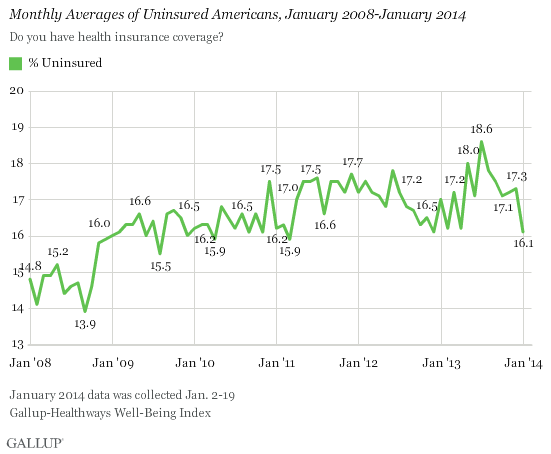
Gallup has released a new poll reporting that health insurance coverage among American adults increased modestly in January 2014, the first month that the Affordable Care Act health insurance exchange and expanded Medicaid policies were operating.

The graph below shows the estimates over time of the percentage of Americans who were uninsured--the insurance rate is 100 minus these figures and trends in the opposite direction.*


The poll, which interviewed 9,000 U.S. adults, has a sampling error, so the actual January figure is likely somewhere within 1 percent up or down of the reported figure.

Demographic breakdowns in the poll indicate that insurance coverage increased among all groups, with women, non-whites, people aged 35-64, middle-income families, and the unemployed experiencing the greatest gains in coverage.

Although the figures are consistent with the ACA improving health care coverage (that is, with increases in health exchange and Medicaid coverage outweighing the cancellation of some private plans and long-standing trends that had reduced private coverage), it's still too early to tell from poll results. As the chart above shows, sampling error causes the estimates to bounce around from month to month.

*Update 1/23/14 9:56 a.m.: Following up on a suggestion by Andy Brod, the post has been updated to clarify that the graph shows the uninsurance rate.

Tuesday, January 21, 2014

Benefits from NC pre-school programs

A new peer-reviewed study by Duke researchers in the Journal of Policy Analysis and Management shows that North Carolina's Smart Start and More at Four (now the NC Pre-Kindergarten) pre-school programs substantially improve third-graders' reading and math test scores.

The researchers linked third-graders' scores on standardized Spring reading and math tests to the counties where those third-graders were pre-schoolers. They then calculated county averages of the per-child spending on the Smart Start and More at Four programs for the years that each child was growing up.

The researchers focused on the years when both programs were being ramped up and found that spending on both programs was significantly and substantially positively associated with math and reading scores. The results held even in complex multivariate models that also accounted for the children's personal and family characteristics, county-specific effects, and time-effects.

The research is important in establishing the effectiveness of both programs. In particular, it shows that both programs have impacts that reach several years into elementary school.

However, it also shows the consequences of recent actions by Republican General Assemblies to slash these programs. In 2011, permanent state funding for Smart Start was cut by one-fifth, and one-time budget cuts along with state cuts to local governments reduced spending further. That same 2011 budget also sharply cut the NCPK program. Although Gov. Perdue replaced some of those funds through temporary allocations, that relief was not maintained in the 2013-5 budget.

The consequences will appear later this decade when the current cohort of pre-schoolers reach third grade with weaker reading and math skills.

And as that noted educational authority, Speaker Thom Tillis, has pointed out, "Students who can read at grade level by the end of third grade are four times more likely to graduate than those who cannot." 

So the decade that follows isn't looking so good either.

Monday, January 20, 2014

NC grading charter school applications on a curve

Basic grammar and punctuation skills might be requirements for students in North Carolina schools, but they aren't requirements for opening a charter school in the state--especially if you're the son of the NC Senate Majority Leader.

In nearby Rockingham County, Philip Berger Jr.'s Providence Charter School was just granted approval to begin taking public funds, despite an application that is riddled with errors.

The errors start on the second page, where the wrong date is used, but they continue.

For example, the application explains on page 9 that
...students who aspire to earn a college degree...do not receive adequate attention or a challenging and demanding curriculum because of mindset that they are performing 'adequately'...because these students are viewed self-sufficient, little is demanded of them. We strive for excellence." 
Well, selective excellence that doesn't rely on attention to detail.

Saturday, January 18, 2014

Busy first year for Gov. McCrory's DHHS

It's easy to lose track of all the skeevy, incompetent, and harmful things that Gov. McCrory's Department of Health and Human Services has done over the last year.

Don't worry though, WRAL has compiled a handy summary.

As you slowly shake your head at this sorry record, remember that the problems are all the fault of [insert as needed: former Gov. Perdue, current President Obama, naysayers, liberal naysayers, the liberal media, liberals generally, damnable computers, even more damnable statistics, county agencies, federal agencies].

Friday, January 17, 2014

Business writers fooled by randomness

Earlier this week, the News-Record, Triad Business Journal, and Ed Cone reported on the "good news" of Winston-Salem moving up 38 places in the Milken Institute's 2013 ranking of "best performing large cities." In particular, Winston-Salem's ranking improved from from 174th out of 200 in 2012 to 136th in 2013.

These types of rankings warrant much more skepticism than the business press gives them. This is especially true of the Milken report, which bases its rankings on an index compiled primarily from estimated numbers on job growth, wage and salary growth, and "high-tech GDP" growth for metropolitan statistical areas.
Consider the estimates of job growth. These are constructed by taking the difference of estimates of the number of jobs in an end period and a base period. Because each of the estimates is based on a sample of employers and not all employers, they are subject to sampling variability (much  the same way that public opinion results are being correct within a few percentage points). Sometimes the estimates are a little higher than the true value; sometimes they are a little lower. If the estimates are unbiased and the errors are uncorrelated over time, very high errors on the positive side tend to be followed by lower errors or errors on the negative side, and very low errors on the negative side tend to be followed by higher errors. This causes a phenomenon known as "regression to the mean" in which big positive or negative growth rates in one period tend to be followed by smaller growth rates in the next period.

Regression to the mean issues become even more pronounced when the underlying statistics are rankings and have upper and lower boundaries. For cities at the bottom of the rankings, there's no place to go but up (logically, Winston-Salem couldn't have moved down 38 places). Similarly, for cities at the top, there's no place to go but down.

The Milken Institute lists the 20 cities than gained the most positions from 2012 to 2013; of these, 19 came from the bottom half of the distribution. Of the 20 biggest losers, 14 came from the top half of the distribution.

These problems are magnified with there is more variability in the estimates. Measured variability decreases with sample size. Unless special provisions are taken to over-sample people and businesses in small cities, the estimates for cities like Winston-Salem will jump around more than their larger cousins. Indeed, Winston-Salem's has jumped all over the place across the years--136 in 2013, 174 in 2012, 164 in 2011, 119 in 2010, and 92 in 2009.

Not only are the data that form the Milken Index subject to variability, but some series are incomplete and preliminary. In particular, several parts of the index are based on "high-tech GDP" growth. Milken does not describe the specific series that are used but does indicate that they come from the Bureau of Economic Analysis (BEA) metropolitan GDP estimates. The BEA figures are not especially timely. The latest data are advanced estimates for 2012 that are not final and are subject to substantial revision. Also, estimates for the sets of industries that would be needed for a "high tech" figure aren't released for all cities in every year.

Finally, whatever information can be gleaned from the index is almost all dated. There are nine components of the 2013 index. Only one actually comes from 2013. Six components describe growth rates that ended or outcomes that occurred in 2012, and two components describe growth rates that ended in 2011.

Did Winston-Salem really change from being one of the best performing cities in 2009 to one of the worst in 2012? I doubt it.

Business writers should doubt it too.

Thursday, January 16, 2014

SNAP in NC wasn't broken before

The North Carolina Department of Health and Human Services (DHHS) under Governor Pat McCrory and Secretary Aldona Wos has fouled up one task after another. As I've been discussing in the last few posts, the department's problems with its NC FAST have delayed food assistance for tens of thousands of disadvantaged households, creating a different kind of NC FAST.

A constant refrain from Gov. McCrory and Sec. Wos throughout these debacles has been that they inherited a "broken agency." Records from the U.S. Department of Agriculture, however, reveal a different story and show that the previous administration managed its Supplemental Nutrition Assistance Program (SNAP, formerly the Food Stamp Program) caseload competently.

Each year, the USDA measures state agencies' effectiveness in administering the SNAP in three ways:
  • Payment accuracy, which is determined by quality control checks of the percentages of over-payment errors and underpayment errors;
  • Application processing timeliness, which is determined by quality control checks of the percentage of SNAP applications that were resolved within statutory limits of 30 days for regular cases and 7 days for expedited cases, and
  • Program access, which is measured as the ratio of SNAP participants to people with incomes below 125 percent of the poverty line (it approximates the proportion of people who are eligible for SNAP on the basis of their gross incomes who actually get benefits).

Under former Gov. Perdue, the DHHS performed well under all of these categories.

In fiscal year (FY) 2012, NC had an overall payment error rate of 2.32 percent, which was substantially below the national rate of 3.42 percent. The state's error rate was falling from 2.65 percent in FY 2011 and 2.70 percent in FY 2010--percentages that were also lower than the national averages for those years.

Wednesday, January 15, 2014

Blame-shifting during the NC FAST

Disadvantaged households in North Carolina applying to begin or continue receiving help from the Supplemental Nutrition Assistance Program (SNAP, formerly the Food Stamp Program) have suffered through unprecedented and unconscionable delays ever since the state made changes to its NC FAST processing system in July.

Within a month of the switch-over, the backlog of unprocessed applications and recertifications ballooned to nearly 70,000.

By November, NC was reporting to the U.S. Department of Agriculture (USDA) that approximately 22,500 households still had applications or recertifications delayed by at least a month and that approximately 6,500 households had those actions delayed by at least three months. The delays caused the USDA to warn that it would have to withhold the federal share of SNAP's administrative funding if processing did not improve.

Instead of improving, the state's backlog grew worse in December.

The delays have led to another kind of NC FAST, one in which poor families go hungry and in which food pantries are depleted.

Throughout this self-inflicted debacle, the state official "responsible" for the administration of SNAP, State Health and Human Services Secretary Aldona Wos has cast blame far and wide--basically everyplace except the agency that she runs.

Targets of Secretary Wos' blame-shifting include:
  • Former Gov. Perdue. Sec. Wos claims she inherited a broken agency; nevermind that the switch-over to NC FAST occurred on Sec. Wos' watch, that the previous agency managed to get food stamp applications processed in time, and that Sec. Wos has been on the job for a year.
  • County case workers. Processing of food stamp applications slowed to a trickle immediately after the NC FAST system was introduced in July. Sec. Wos blamed county case-workers for being inadequately trained on her super-duper system, and her state social services director told case workers to "consult the training tool." But even as she and her staff said this, Sec. Wos had records showing show that nearly all county workers had been properly trained. It turns out that processing slowed to a crawl mainly because Sec. Wos' system did not work on the Internet Explorer browser--something county workers discovered on their own and had to point out to her. The browser problem went undiagnosed for a month by Sec. Wos' crack staff; meanwhile the unprocessed applications and recertifications continued to pile up.
  • The media. Sec. Wos also blamed news organizations for creating a panic that led to excessive calls and inquiries to county agencies. However, as the delays in SNAP processing not only continue but grow worse, the media-did-it explanation wears thin.
  • President Obama. Sec. Wos now blames President Obama and the Affordable Care Act for her agency's problems. The ACA requires states to streamline and align applications to the Medicaid and S-CHIP public health insurance systems with other social insurance programs, including SNAP. However, the rules for making these alignments were proposed in August 2011 (two years before NC FAST came on line) and finalized in March 2012 (15 months before the system went live). In other words, the rules were in place when Sec. Wos walked through the door. Moreover, the rules for SNAP change frequently. There are changes with almost every major farm bill, changes associated with the American Recovery and Reinvestment Act, and changes when states request and received special waivers from the SNAP rules. Somehow other states managed to successfully navigate the rule changes, but Sec. Wos's agency did not. Change in the SNAP has many precedents; the delays experienced by poor NC families do not.
  • Bad numbers. Sec. Wos's agency is also now blaming bad numbers for over-stating the delays associated with the NC FAST system, with her state social services director testifying that "as many as half of the those numbers we're reporting to USDA may be of folks who have a duplicate of another application pending." This excuse makes it sound like the numbers magically appeared and ignores the fact that they were generated by Sec. Wos' own NC FAST system. Also, even if half the applications and recertifications are duplicates, there are still tens of thousands of desperate NC families waiting for food assistance.
  • The U.S. Department of Agriculture. Sec. Wos's agency has taken issue with USDA's definition of "untimely."
Previous administrations have routinely processed SNAP applications and recertifications; other states are successfully processing them now.

Sec. Wos' blame-shifting is as unproductive as it is unprofessional. Despite working in her position with a salary of only $1 per year, she is clearly being overpaid. It's long past time to bring in responsible leadership.

Hungry families in NC deserve no less.

Tuesday, January 14, 2014

NC Unemployment Insurance cuts hurting job growth

This past July, North Carolina's Unemployment Insurance (UI) program got leaner and a whole lot meaner when Governor McCrory and the Republican legislature cut both the number of weeks of state-funded compensation and the maximum benefit for workers. These cuts, in turn, led the federal government to cancel extended UI benefits for 70,000 long-term jobless people in the state.

Republicans claimed that the cuts would be a dose of tough medicine, spurring the jobless to accept work and leading to employment growth.

However, the cuts had the opposite effect--job growth, which was already anemic in the state, has actually slowed.

Moving the wrong direction in NC
June-November Job Growth before UI slashed
1.50%
June-November Job Growth after UI slashed
1.35%

Figures from the U.S. Bureau of Labor Statistics indicate that the number of non-farm jobs in NC increased 1.35 percent from June 2013 (the month before UI was slashed) to November 2013 (the latest month available).

Over the same months in 2012, when the more generous UI state and federal systems were in place, the number of non-farm jobs increased by 1.50 percent.

Nationally, job growth from June to November was faster in 2013 than in 2012, so NC's slowdown bucks the national trend.

Why did job growth slow? Although the elimination of UI for NC's long-term unemployed may have spurred a few desperate people to take jobs, it took money out of the pockets of many, many more. This reduced the demand for goods below what it would have otherwise been and thereby lowering the demand for labor.

The policy not only punished down-on-their-luck workers (eligibility for UI requires a history of work) but also punished businesses and other potential workers across the state.

Leaner, meaner, and dumber.

Monday, January 13, 2014

SNAP delays getting worse

Despite the U.S. Department of Agriculture (USDA) threatening to cut off administrative funding for North Carolina's bumbling Supplemental Nutrition Assistance Program (SNAP, formerly the Food Stamp Program) and despite DHHS Secretary Aldona Wos promising that things were improving, WRAL reports that delays in processing SNAP applications and recertifications got 50% worse in December.

The November figures, which partly prompted the USDA warning, indicated that 22.500 households had their SNAP applications or recertifications delayed by at least a month and that 6,500 had those actions delayed by at least three months.

By the end of December, the number of households with applications or recertifications delayed by at least a month was 33,000 and the number with actions delayed by at least three months was 9,200. Several thousand households also had actions delayed by more than four months.

Far from improving, the delays in getting food assistance to needy families--delays that literally take food from the mouths of poor families and children--are getting much, much worse.

Meanwhile, as calls grow louder for a competent administrator to replace Secretary Wos, a spokesperson for Governor Pat McCrory said that the Governor "embraces solutions, not gimmicks."

Apparently hunger is a solution.

Thursday, January 9, 2014

Wos: Hungry North Carolinians "in a very good place"

The NC FAST computer system, which was brought on line this summer to administer North Carolina's Supplemental Nutrition Assistance Program (SNAP, formerly the Food Stamp Program), has suffered one catastrophic problem after another delaying food assistance for tens of thousands of vulnerable households and frustrating caseworkers who try to help those households.

WRAL reports that despite assurances from DHHS Secretary Aldona Wos and some of her highly-paid but thinly-vetted spokespeople that the problems were resolved, tremendous problems remain.

In November, Secretary Wos told WRAL that the NC FAST system was "in a very good place right now."

However, one month later, an official from the U.S. Department of Agriculture, the federal agency that funds SNAP, threatened to suspend the state's administrative funding for the program, writing
The data  provided by DHHS indicates that more than 20,000 households continue to experience significant delays with Supplemental Nutrition Assistance Program (SNAP) applications and recertifications. Of these households, over 6,000 have been waiting for more than three months to receive benefits. The delays are completely unacceptable and a serious failure on the part of North Carolina.
Delays of over three months for food assistance for more than 6,000 of NC's neediest families are unconscionable.

Yet that's the way that things roll in Raleigh these days where the McCronies exact the Tea Party's vengeance on the poor.

Earned Income Tax Credit? Gone.

Federally-funded extended unemployment insurance benefits? Forfeited when the state cut its own UI program.

Federally-funded Medicaid benefits for low-income adults? Don't need it.

SNAP? Fill out an application and Secretary Wos will get back to you in three months, if you're lucky.